Science fact thread

Back off, hard science types - it's archaeology time

New techniques (or newly-employed techniques) looking at Egyptian sites have produced astounding results - have a look. The size of the ancient city of Tanis is quite incredible. I'm really looking forward to that documentary on Monday.

Also, Tanis is a real place?! What next, Alexandretta?
 
watching the documentary I couldn't shake the image of spock starring into the 'scanner' on enterprise. That whole multitouch screen they were carting about and the 'sci-fi' interface were such a crutch. I found it pretty funny. Bet they had to turn it upside down and empty sand out of the filters each day.
 
I never understood why Spock had to use such a small monitor. Why didn't he get a big screen like everyone else? That's no good for TIVOing alien gladiator fights.
 
Does anyone know anything about anti-gravity? Specifically, how plausible is it? I've read about O'Neill cylinders (the rotating structure seen in Ender's Game, Avatar and others) but how would this apply to an entire structure?
 
Anti-gravity and artificial gravity are different things, usually.

Anti-gravity -- as in, some force that works opposite to gravity, making a dipolar system of gravity -- hasn't been seen to exist and probably doesn't, except for dark energy/dark matter which seems to repel objects rather than attract them.

Artificial gravity, or induced g, is a mechanical process of centripetal force. Similar to water in a bucket being swung in a circle, if you spin a cylinder in space the same will happen to objects inside. A complex rotation (2 or 3 axial rotation) will produce an inconsistent force, so it would be a single axle (like a spinning top, or the swinging bucket).

The size of the rotating body isn't a major problem -- the force will exist that replicates gravity -- until you have a very large structure with high mass. The more mass, the more difficult it will be to hold it together under the force of the rotation. Spin a CD fast enough and it flies apart:

http://www.youtube.com/watch?v=Hc3KlEZ2uds&feature=related

It's really light, so it needs a lot of speed to get it to fly apart. Mass, and major structural integrity issues get to be problems.
 
Last edited:
I meant artificial gravity. Anti-gravity is technically impossible and I can't see how it would be all that useful in a practical sense. But what I want to know is how plausible artificial gravity is and whether experiments have been done on it or not. Thanks for the feedback.
 
I meant artificial gravity. Anti-gravity is technically impossible and I can't see how it would be all that useful in a practical sense. But what I want to know is how plausible artificial gravity is and whether experiments have been done on it or not. Thanks for the feedback.

What do you mean by anti-gravity and why is it technically impossible?

Suppose we could sort of turn off gravity or control its strength.

The rotation of a planet could furl a ship into space if the gravitational attraction could be reduced sufficiently.

psik
 
Oh thanks for the tip.
What do you mean by anti-gravity and why is it technically impossible?

Suppose we could sort of turn off gravity or control its strength.

The rotation of a planet could furl a ship into space if the gravitational attraction could be reduced sufficiently.

psik
Do you know of a means by which it's theoretically possible? I don't.
 
antigravity; where I sit (with my very limited knowledge, and accepting that this is based on speculative theories from which I clearly cherry pick my favourites)

http://en.wikipedia.org/wiki/Graviton#Gravitons_in_speculative_theories

if the reason for the weak interaction of the gravity particle (or string, quata, whatever) is that they coincide at an incident angle to our spacetime, thereby causing the 'popping in and out of existence' feature, then to block the interaction one would need to block the graviton. This can't be accomplished as one might with a faraday cage, we'd need to be effectively locking out at a higher dimensional order.

I am not hopeful, but don't rule it out.

Good luck to anyone trying to answer this one!

:)
 
Last edited:
ok, looking into this slightly further

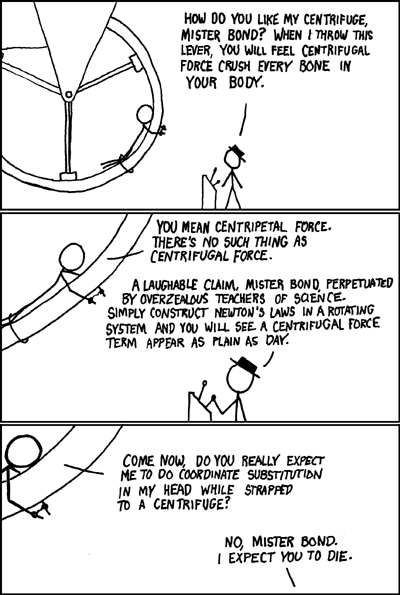
if we ASSUME that one can block the interaction of gravitons (assuming first there is a gravity particle) then you can potentially turn off the effect of gravity locally to that system, but then you'd essentially be unhooked from the whole gravitational framework of space, so you immediately displace with respect to your original 'location', in relation to all the various spins you used to be subject to. Would that be centrifugal (as opposed to centripetal) dislocation since you have your own separate frame?

centrifugal_force.png


Anyway, the object, or you, would be uncontrollably OFF into space.

You can't STEER gravity as that implies a metamaterial style bending of gravitons around an object which violates conservation of energy since a completely bent gravity loop generates energy (apparently)...

The best bet seems to be simply modulating a graviton exclusion system in time domain as that has the same end result of whizzing off, but with a variable intensity so you could inherit a curve from whatever local spacetime you're passing through by pulsing just right and presumably calculate your way through gravitational space corridors generated by large bodies.
 
Last edited:
whoops, I missed the point again. Artificial gravity. No idea. Maybe something like a material for trapping gravitons?

if it's possible for light
http://www.nature.com/nature/journal/v445/n7128/full/nature05493.html

Here we demonstrate that a slow light pulse can be stopped and stored in one Bose–Einstein condensate and subsequently revived from a totally different condensate,

who knows.

Well beyond my ken this.
 
Thanks for all the info, pox. I'll take the time to digest it all later.

When you said "gravity particle", I was reminded of something I read the other day to the effect that gravity isn't really anything tangible - it's just relativity. I can't remember where I read this, though. Possibly on this very forum.

(And I love xkcd for making science accessible to lowly liberal arts majors like me.)
 
Oh thanks for the tip.
Do you know of a means by which it's theoretically possible? I don't.

Of course not. If I did I would be working on it but not tell you. But just because I don't know that it is possible does not mean there is a way of knowing that it is IMPOSSIBLE.

There is a HUGE I don't know range between Possible and Impossible. The Sun didn't need for us to know about fusion in order to run on what we eventually called fusion.

psik
 
Last edited:
You're an experimental physicist?

I prefer to calling things impossible when the scientific community agrees they are, until new evidence appears. Eg. "FTL travel is currently impossible."

"When the facts change, I change my mind." - John Maynard Keynes
 
Anti-gravity could only really be synthesized through something like exotic matter, which has a negative energy density. This means it would work in the opposite direction to gravity and have "negative" mass. Exotic matter is also one way you could theoretically stabilize the throat of a wormhole to allow for interstellar travel.

Please note exotic matter has never been observed, and this is different from antimatter, which has.
 
Speaking of that, does anyone know about potential methods of propulsion for interstellar travel? Clearly current methods won't get us the span of a few light-years in anything less than decades.
 

Sponsors


We try to keep the forum as free of ads as possible, please consider supporting SFFWorld on Patreon


Your ad here.
Back
Top