65 million years ago, a meteorite collided with vast energy into the Yucatan area, wiping out the dinosaurs, and allowing some scurrying little rat-like creature to evolve into the many suddenly vacant ecological niches, eventually resulting in...well you know who...
The descendants of that rat are now discovering that the dinosaurs also had their own stage clearing ecological event that allowed
them to dominate like no other species for eons.
Dawn of the Dinosaurs
Lately, though, new discoveries have begun to flesh out the script of dinosaurs’ earliest days. From ghostly footprints in a Polish quarry to the bones of a pint-sized predator in Argentina, these findings tell a more complete and nuanced tale of dinosaur genesis. Dinosaurs, it turns out, were not predestined to rule the planet for more than 130 million years. Instead, dinosaurs appeared on the scene tentatively, perhaps as early as 250 million years ago.
Paleontologists are now unearthing fossils so primitive that they may be close to the common ancestor at the root of the dinosaur family tree — the “ur-dinosaur,” as Paul Sereno of the University of Chicago puts it. Ingloriously, that creature probably looked something like a chicken: two-legged, scurrying around in the corners, snapping up plants, insects, small animals and whatever else passed its way.
.
In your face T REX you chicken!
Beyond dinosaurs, those new groups included the ancestors of creatures that would look familiar today, such as lizards, frogs and salamanders. These animals — in particular, the crocodile-like creatures known as crurotarsans — were far more abundant than the first dino pip-squeaks. “If you were standing in the Triassic, you would say these crocodile-like animals, not dinosaurs, would expand and be dominant” in the eons to come, says Brusatte.
Which makes me wonder how these creatures might have evolved if first the dinosaurs and then mammals had not become the dominant species? Since these creatures are still around, it would seem their types have not really evolved many improvements over the original models because they occupy fewer ecological niches?
How did such specimens come to dominate the planet? Somehow these runty chickenlike creatures managed to give rise to the formidable T. rex, Triceratops, Stegosaurus and more.
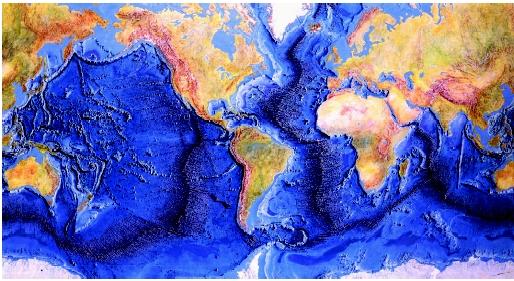
One clue may lie in yet another mass extinction. Around 200 million years ago, at the end of the Triassic period, something traumatic happened on Earth. As Pangaea began splitting apart, great quantities of magma poured out along the planetary seam that would become the middle of the Atlantic Ocean. Atmospheric carbon dioxide levels spiked, and the chemistry of the oceans shifted dramatically.
Life suffered. Crurotarsans and other non-dino reptiles were some of the worst-hit creatures, losing large fractions of the species living at the time. Their disappearance opened up ecological niches — and may have been the lucky break dinosaurs needed to move into new roles, many scientists think. (Similarly, mammals got the chance to rise to prominence after most of the dinosaurs were wiped out.)
Plate tectonics is an absolutely fascinating subject to me, and the fact that the Mid Atlantic Ridge, something we heirs to the evolutionary throne have only been aware of since the 1960's, is one of the major evolutionary engines of massive species trauma is eye-opening.
The ridge is actually part of the Mid-Ocean Ridge, the world's longest mountain range, it is some 40,000 miles long. It winds around the Earth like a seam on a baseball, starting somewhere around Iceland, it ends up off the coast of Mexico, passing quite near the Galapagos Islands. (probably the source of their own geological formation as well.) Quite apt that ending point when you think about it.
A few more thoughts occur to me. If we mean to find planets beyond our solar system that support life beyond mere microbes, seems logical that we will need to seek planets that have tectonic processes.
Secondly, I think these findings open up some new avenues for SF writers to pursue. I know Harry Harrison had his West of Eden series which was certainly credible and well regarded by some, but somehow left me unsatisfied with the results.
I would like to see a good SF book about a "what if" the dinosaurs had evolved intelligence, or even better, a "what if" it was one of these other species the dinosaurs replaced, like the salamanders, or even better, the
chameleons:
Perhaps somewhere in our vast galaxy, something like
this got a few tectonic breaks, while also under the protection of a vast planetary molten-core generated magnetic field, got a few more breaks from the cosmic casino, maybe a meteorite or two, or a strategically placed oceanic ridge massive event, and eventually evolved into various ecological niches, culminating in enough intelligence to put some of the puzzle pieces together and wonder if the same thing happened anywhere else?
Any suggestions for SF titles along these lines are welcome. (Or maybe I should give it a whirl myself? )


 can be devastating and as for the sarcastic use of
 ......