Science fact thread

It has been far too long since I took a physics course, and this is more advanced than the balistics I use in hunting, so could you explain this to me.

If the bullet creates 2 g of lift it would rise at a rate of 9.8M/s/s. -9.8M/s/s for gravity +19.6 M/s/s for lift giving a net positive effect. In my experience bullets don't act that way.

no idea. no idea at all. looks like nonsense to me. I was being a touch incredulous in my post but I think that failed to come across.
 
I find I can't help myself. I need to either correct what I think is a mistake, or find out why my thinking is wrong. I've always found that it's better to learn the facts as soon as possible. That way I can be the smart arse in the pub next time. :D:D:D
 
I find I can't help myself. I need to either correct what I think is a mistake, or find out why my thinking is wrong. I've always found that it's better to learn the facts as soon as possible. That way I can be the smart arse in the pub next time. :D:D:D

absolutely same here, and don't misinterpret me as irked. This has got over the hump as a subject for me from mundane theoretical physics, through normal predictable experiential report of behaviour, into just pain weird simulations. I am awaiting clarification myself here or else will have to find it. I am not above ripping that book off the net to check since I am not paying 60 dollars to find one fact. I'll have to get back to this as I'm on a law course today.

note the video shows deviation in inches and explains this matches ditributions of shot patterns. clearly not 2g across whole flight time, but duration of lift is not specified against flight time. even if you assume a lift effect before dynamic 'sleep' then it fails to match the graph on the right. maybe a 2g muzzle effect kick resulting in the parabola shown. At peak round 100 yards that's a deviation from target that wouldn't get picked up by the experience of even hunters on here as environmental effects would reign. It does suggest there's more to learn and I don't consider that getting bogged down at all. If this small technical effect exists then it doesn't change the effect of normal simple balistics and is a separate debate.
 
What have I created?!

My word, I've set you all off! Excellent. BUT remember the original statement involved a pistol; no bringing in hunting rifles or tanks (tanks?!). And the fired pistol is level with the hand dropping the bullet, so talk of parabolic flight and suchlike is not admissable. Even a meathead like me can readily understand that a gun fired with an upward tilt, or a more powerful gun than a hand-held pistol type, must surely produce different results. I know that the kind of rifles used by snipers in the military can have quite fearsome ranges these days. And although psikeyhackr's last post appears to have met with a mixed response, I have to say he's quite right in his first comment, at least in relation to MY first comment - it's the disconnect between everyday "common sense" and the reality of physics which is so interesting here. The two bullets hitting the ground at the same time just instinctively feels wrong; it makes no sense to me, even now. Indeed, the host of the show from which this arises said himself "I sort of don't believe it myself, even though I know it's true." (At 28:25, if you want to check it out.) Alan Davies' response encapsulates my feelings perfectly.

To lighten the mood, I can't resist posting something I heard on the radio yesterday - the topic was, silly things you've heard in quizzes, tests, etc. The question in a pub quiz was "How many times is the Sun larger than the Moon?" - the caller's friend had answered "Isn't it always larger?":eek:
 
To lighten the mood, I can't resist posting something I heard on the radio yesterday - the topic was, silly things you've heard in quizzes, tests, etc. The question in a pub quiz was "How many times is the Sun larger than the Moon?" - the caller's friend had answered "Isn't it always larger?":eek:

As long as the question is not rhetorical, (since I agree the followup is much funnier) the answer to the question is easy, and it is a weird science fact I brought into this thread a few months ago.

The Sun is around 400 times larger then the moon. The Sun is also almost exactly 400 times farther away from Earth then the moon is from Earth. That is why during an eclipse, the Sun and the moon appear to be almost exactly the same size when viewed from Earth.

No doubt this strange coincidence has led to scientific astronomical insights that would not have been made otherwise, especially in the early days of astronomy.

The Sun's corona for instance, is only visible to us on Earth during an eclipse because of that little "400 times" quirk.

The Universal Scale linked earlier gives some great comparisons to the actual sizes of all 3 bodies. For instance it showed that the width of the United States would actually be a bit larger then the diameter of the moon. The Sun on the other hand is around 800,000 miles across, nearly a million miles wide!
 
Larger is a little vague. Do you mean diameter, volume, mass or apparent width from an Earthly viewpoint. From Earth the apparent size of the Sun and Moon changes, that is how we have annular and total eclipses.
 
:D:D

While I'm at work I often find myself saying 'Sort off, but it's a bit more complicated than that' when some manager asks me a question.

Should be a motto for the scientific and engineering community. :)
 
I find myself asking for people to define their terms a lot in the same environment...
 
I never really 'got' smilies until I started posting on here. Now any time I write something that I think could read ambivalently I try to add a smiley or two to indicate the tone of voice I'm using. Of course you then run into the problem of not having a precisely accurate smiley to use. Many wars have been started by the inappropriate use of smilies. A well placed :rolleyes: can be devastating and as for the sarcastic use of :confused:......

Now, which one best indicates a post intended to be read with lightly humorous overtones? :)......:D
 
:D:D

While I'm at work I often find myself saying 'Sort off, but it's a bit more complicated than that'

:) Me too but sometimes things are not as complicated as one might think...:D


The Sun's distance from the Earth is about 400 times the Moon's distance, and the Sun's diameter is about 400 times the Moon's diameter. Because these ratios are approximately the same, the Sun and the Moon as seen from Earth appear to be approximately the same size: about 0.5 degree of arc in angular measure.

http://en.wikipedia.org/wiki/Solar_eclipse

In absolute terms, the Sun and the Moon couldn’t be more different in size. The Sun measures 1.4 million km across, while the Moon is a mere 3,474 km across. In other words, the Sun is roughly 400 times larger than the Moon. But the Sun also happens to be 400 times further away than the Moon, and this has created an amazing coincidence.

From our perspective, the Sun and the Moon look almost exactly the same size. This is why we can have solar eclipses, where the Moon passes in front of the Sun, just barely obscuring it from our view.

And this is just a coincidence. The gravitational interaction between the Moon and the Earth (the tides) are causing the Moon to slowly drift away from the Earth at a rate of 3.8 centimeters per year. In the ancient past, the Moon would have looked much larger than the Sun. And in the far future, the Moon will look much smaller. It’s just a happy coincidence that they look the same size from our perspective.

http://www.universetoday.com/17109/the-sun-and-the-moon/

I don't mean to imply that the coincidence is anything more cosmic then mere coincidence, although some might think it strange that this just happens to be the Earth/Moon/Sun configuration at nearly the exact perfect timing for intelligence to be aware of it.

It is just kind of weird to consider all the billions of combinations and permutations of this sort of orbital alignment that are possible in the vast cosmic casino, and yet it is our Solar System that got the near match. :D
 
there is some properly weird stuff in the detail of the universe though and no mistake. The human mind is tuned to see and take inspiration from patterns too which really compounds the issue. As if thing weren't weird enough, they're weirder by far, and we as a species get weirded out by the number 21 ffs...

:)
 
65 million years ago, a meteorite collided with vast energy into the Yucatan area, wiping out the dinosaurs, and allowing some scurrying little rat-like creature to evolve into the many suddenly vacant ecological niches, eventually resulting in...well you know who...

The descendants of that rat are now discovering that the dinosaurs also had their own stage clearing ecological event that allowed them to dominate like no other species for eons.

Dawn of the Dinosaurs

Lately, though, new discoveries have begun to flesh out the script of dinosaurs’ earliest days. From ghostly footprints in a Polish quarry to the bones of a pint-sized predator in Argentina, these findings tell a more complete and nuanced tale of dinosaur genesis. Dinosaurs, it turns out, were not predestined to rule the planet for more than 130 million years. Instead, dinosaurs appeared on the scene tentatively, perhaps as early as 250 million years ago.

Paleontologists are now unearthing fossils so primitive that they may be close to the common ancestor at the root of the dinosaur family tree — the “ur-dinosaur,” as Paul Sereno of the University of Chicago puts it. Ingloriously, that creature probably looked something like a chicken: two-legged, scurrying around in the corners, snapping up plants, insects, small animals and whatever else passed its way.
.
In your face T REX you chicken!
Beyond dinosaurs, those new groups included the ancestors of creatures that would look familiar today, such as lizards, frogs and salamanders. These animals — in particular, the crocodile-like creatures known as crurotarsans — were far more abundant than the first dino pip-squeaks. “If you were standing in the Triassic, you would say these crocodile-like animals, not dinosaurs, would expand and be dominant” in the eons to come, says Brusatte.

Which makes me wonder how these creatures might have evolved if first the dinosaurs and then mammals had not become the dominant species? Since these creatures are still around, it would seem their types have not really evolved many improvements over the original models because they occupy fewer ecological niches?

How did such specimens come to dominate the planet? Somehow these runty chickenlike creatures managed to give rise to the formidable T. rex, Triceratops, Stegosaurus and more.

One clue may lie in yet another mass extinction. Around 200 million years ago, at the end of the Triassic period, something traumatic happened on Earth. As Pangaea began splitting apart, great quantities of magma poured out along the planetary seam that would become the middle of the Atlantic Ocean. Atmospheric carbon dioxide levels spiked, and the chemistry of the oceans shifted dramatically.

Life suffered. Crurotarsans and other non-dino reptiles were some of the worst-hit creatures, losing large fractions of the species living at the time. Their disappearance opened up ecological niches — and may have been the lucky break dinosaurs needed to move into new roles, many scientists think. (Similarly, mammals got the chance to rise to prominence after most of the dinosaurs were wiped out.)

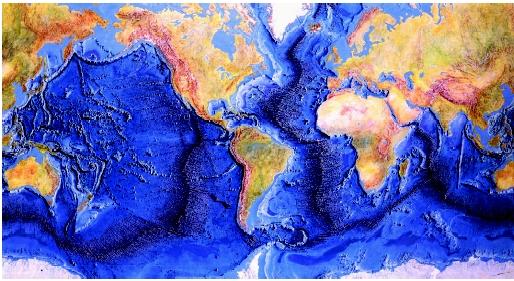
Plate tectonics is an absolutely fascinating subject to me, and the fact that the Mid Atlantic Ridge, something we heirs to the evolutionary throne have only been aware of since the 1960's, is one of the major evolutionary engines of massive species trauma is eye-opening.

The ridge is actually part of the Mid-Ocean Ridge, the world's longest mountain range, it is some 40,000 miles long. It winds around the Earth like a seam on a baseball, starting somewhere around Iceland, it ends up off the coast of Mexico, passing quite near the Galapagos Islands. (probably the source of their own geological formation as well.) Quite apt that ending point when you think about it.

wsci_03_img0352.jpg


A few more thoughts occur to me. If we mean to find planets beyond our solar system that support life beyond mere microbes, seems logical that we will need to seek planets that have tectonic processes.

Secondly, I think these findings open up some new avenues for SF writers to pursue. I know Harry Harrison had his West of Eden series which was certainly credible and well regarded by some, but somehow left me unsatisfied with the results.

I would like to see a good SF book about a "what if" the dinosaurs had evolved intelligence, or even better, a "what if" it was one of these other species the dinosaurs replaced, like the salamanders, or even better, the chameleons:

1panther_chameleon.jpg


Perhaps somewhere in our vast galaxy, something like this got a few tectonic breaks, while also under the protection of a vast planetary molten-core generated magnetic field, got a few more breaks from the cosmic casino, maybe a meteorite or two, or a strategically placed oceanic ridge massive event, and eventually evolved into various ecological niches, culminating in enough intelligence to put some of the puzzle pieces together and wonder if the same thing happened anywhere else?

Any suggestions for SF titles along these lines are welcome. (Or maybe I should give it a whirl myself? ) :D
 
Last edited:
my goodness me but it takes ages to read brian greens hidden universe

I would be very surprised if it were otherwise. The entire Multiverse concept is not exactly easy to comprehend shall we say.

I anxiously await your selections for favorite version of the Multiverse.:D I'm a bit partial to the relatively simple Quilted Multiverse and of course my favorite is the Holographic Multiverse. That one really has a ring of truth to me.
 
Last edited:
I'm pretty into straight multi-world as things stand but haven't got to the end.

:)
 

Sponsors


We try to keep the forum as free of ads as possible, please consider supporting SFFWorld on Patreon


Your ad here.
Back
Top