


caelveyron
Cael Veyron
- Joined
- Jun 1, 2026
- Messages
- 1
Hello everyone,
I would like to share my new speculative science fiction book:
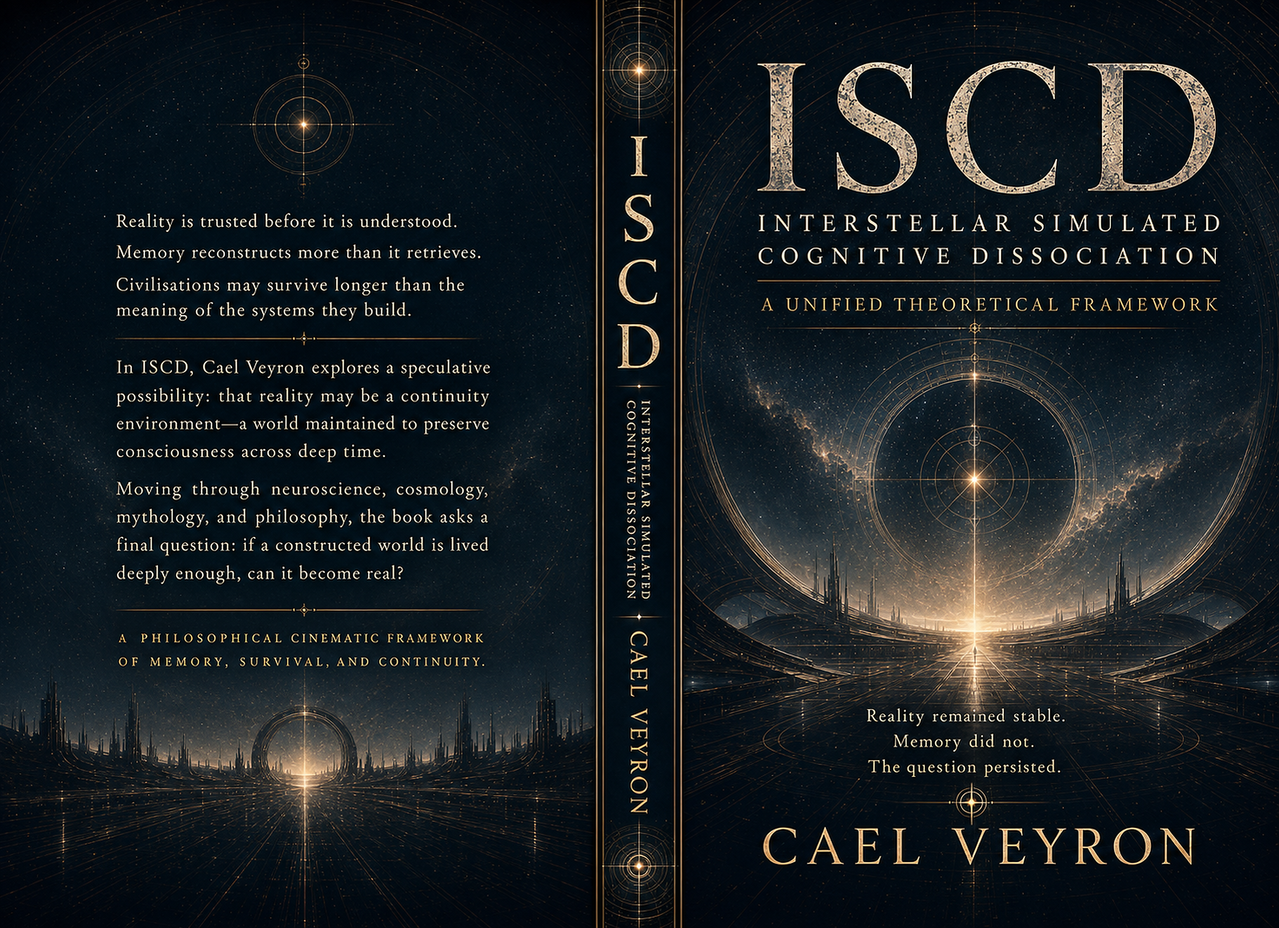
ISCD — Interstellar Simulated Cognitive Dissociation
- A Unified Theoretical Framework by Cael Veyron
The central question behind the book is:
What if simulated reality was not built to deceive us, but to preserve us?
Many stories about simulation begin with suspicion:
Are we prisoners?
Are we being watched?
Is reality fake?
ISCD takes a different approach. It explores the possibility that an artificial reality could function as a continuity environment — a system designed to preserve consciousness, identity, culture, and civilization across extreme distances and durations.
The book begins with ordinary experience: perception, memory, identity, and the fragile sense that reality remains stable from one moment to the next. From there, it moves toward larger questions involving quantum uncertainty, fine-tuning, civilizational silence, mythological recurrence, semantic drift, and possible Dyson-scale survival structures.
Some of the main themes include:
- simulation theory as survival architecture, not deception
- consciousness as continuity rather than static identity
- memory as reconstruction rather than perfect record
- the Fermi Paradox and the silence of advanced civilisations
- deep time and civilisational semantic drift
- mythology as symbolic residue rather than proof
- artificial habitats and interstellar survival
- awakening not as liberation, but as exile
- the possibility that the body remembered inside the system may not match the body beyond it
A few core lines from the book:
Reality is not given. It is maintained.
Memory does not preserve truth. It preserves coherence.
The simulation hypothesis asks the wrong question.
A civilisation entered the system to survive.
The system survived longer than memory.
At its core, ISCD asks whether reality is defined by origin, or by continuity.
If a constructed world is lived deeply enough — if love, grief, memory, culture, suffering, and meaning unfold within it — can it still be dismissed as unreal?
ISCD is available on Amazon in Kindle and print formats.
I would be very interested to hear what science fiction readers think about this approach to simulation theory, especially the idea of simulation not as deception, but as civilizational preservation.
Last edited:

