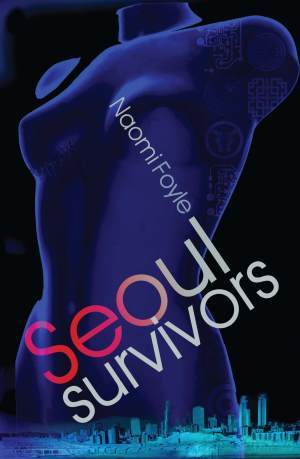
We have talked to Seoul Survivors author Naomi Foyla about her new book and her future plans.
Hello Naomi, welcome to SFFWorld. Who is Naomi Foyle? Why did you want to become a writer?
Thank you, and forgive me if I can’t give a scientifically accurate answer to that first question. Most days I feel like a sublime but secretly volatile cocktail of ingredients that really shouldn’t work but thank heaven somehow do, like a ginger, green apple and cabbage martini. Right now, for example, I’m transitioning from being an international traveller to a breast cancer patient – hence the juicing metaphor! Roots are important too, of course, and not just carrots. Mine trail continents: my late mother was born in India, the great-granddaughter of a Scottish missionary, while my father’s family was a mix of Norfolk farmers, butchers and an Anglican minister. Together my parents took me to live in three continents by the time I was seven, adopting my Chinese sister when we lived in Hong Kong, so although I’m probably a more typical white middle-class British-Canadian than I’d like to believe, internationalism is in my blood. As for why I’m a writer, all that early globetrotting was unsettling for me as a child and I escaped into books, especially SFF. I remember writing to Anne McCaffrey and receiving a postcard in reply that thrilled me to bits – the image was a cartoon of a dragon at a podium, lecturing on the topic ‘Anne McCaffrey: Fact or Fiction?’. Hearing from my favourite writer was inspiring, and I spent a summer with a friend feverishly imagining the space opera world of Zandonia, but it also helped that my mother, the late poet and editor Brenda Riches, encouraged me to write fiction and poetry from a young age.
First of all can you tell us a bit about Seoul Survivors?
The book’s a cyberchiller set in a near-future Seoul, and tells the story of three young people desperate to reinvent themselves in South Korea – Sydney, a brittle blonde Canadian fashion model with a chequered past; Damien, a British slacker obsessed with internet rumours of an impending meteorite strike; and Mee Hee, a gentle North Korean farmer escaping the famine that took the life of her child. Gradually all three fall under the spell of Dr Kim Da Mi, a charismatic Korean-American bioengineer with a seemingly utopian plan to help humanity survive the coming apocalypse. I am afraid to say, however, that thanks in no small part to Da Mi’s sociopathic fixer, Johnny Sandman, some seriously nasty stuff goes on along the way.
 How did you come up with the idea in the first place? What do you feel is unique about your story?
I lived in Seoul for three years in the late nineties, teaching English and generally soaking up the culture. While the country’s elaborate social codes are Confucian, and its ancient traditions from calligraphy to tea drinking can be formal and meditative, at the same time, people were warm and at times dramatic: Koreans tended to be direct communicators, not afraid to show emotion, while young people rebelling against conservative expectations generated a highly creative underground scene. So it was a stimulating time, and the novel emerged in part from experiences I had; books I read; and research I did over the subsequent years. Already influenced by Margaret Atwood, William Gibson, and Kathy Acker, in Korea I read Mia Yun, Yi Munyol and Ahn Junghyo, and Chang Rae Lee, gleaning ideas from all these writers about fertility plots, noir, and the social history of the Hermit Kingdom and its relation to America. I think what I’ve added to the mix is my personal knowledge of Seoul, and also a frank and transgressive approach to sex that is not often seen in SFF. Perhaps, as a foreigner, this was a risky move, but those scenes reflect what I learned about the underbelly of the city, and also critique globalisation and hypermasculinity. Indigenous traditions, of course, are also put under pressure by global capital, but I have to say, that Korean culture, for all its contradictions, felt pretty resilient to me, and I hope my great respect for it comes across in the book.
Can you give us some insight into your main characters?
Some readers find the book’s characters unlikeable, but to me they each have a vital spark that casts their flaws in a more nuanced light. Humour is part of that – though perhaps my sense of humour is rather dark! For me, though, the key to really understanding, and perhaps empathising, with all the characters are their pasts. Da Mi, for example, with her suave intellectual exterior, is clearly driven by her early experience of war and displacement. But while early drafts had longer passages exploring her childhood in particular, I eliminated these because the novel is told from the characters’ points of view, and all of them are blocking out their formative traumas and fixating on the future, come hell or high water. So I dropped hints about the past instead, and kept to the forward momentum.
 You have previously lived and worked in South Korea. Was it easy to choose Seoul as the setting for your story?
The city chose me! Seoul, for me, was a compelling chaos of ancient ceremonies and hyper-real transmodernity: I loved the futuristic fashion and music scenes and the lunar quality of the older aesthetic traditions, arts which prize grace, restraint and harmony with nature. I was struck too by the concept of Han – a historical sense of lament and injustice that binds the nation together. And I was also drawn to the large sense of family my Korean friends experienced in relation to the wider community. This felt very different from Western individualism: I appreciated the way that older people and teachers are highly valued in Korea, while children are a collective responsibility. One of my friends would never lock her car doors when she popped into a shop without her baby – no-one would dream of kidnapping her son; rather everyone on the street would be looking out for him. I couldn’t not write about Seoul, and over the fifteen years it took to get the book published, I kept doggedly returning to the manuscript in part because I was very attached to my memories of the city. I do hope to return one day.
You also have to tell us a bit about The Gaia Chronicles. What were your goals when you started this series? What was your inspiration?
I could have stuck with the cyberchiller genre, but after fifteen years of being in and out of Johnny Sandman’s head I was pretty sick of sexual violence. Revising and proofreading his scenes so intensely over the year leading up to publication, I had almost triggered myself! So one of my goals was to write a book about a young woman growing up in a society that nurtured and respected her sexuality. In addition, in the years since I started Seoul Survivors, climate change had become an irrefutable reality, and I strongly feel that the world needs books that will help us envision a sane and sustainable future. So I decided to write a post-apocalyptic series with an emphasis on rebuilding, beginning with Astra, a coming-of-age story in which the heroine discovers that her nudist, vegan neo-Eden is not quite the paradise it seems. I researched green technologies, and tried to imagine ways in which catastrophe might force us as a species to politically evolve. I set the series in the Middle East because since 2009 I had become heavily involved in human rights work in Israel-Palestine; the books are not a direct allegory of that conflict, but attempt – especially in Rook Song and The Blood of the Hoopoe – to explore the tangled roots of the three Abrahamic faiths in the earlier, more Shamanic religions of the region. From the Sumerian goddess Inanna, King Solomon and the hoopoe, to the Moorish revival architecture of nineteenth century European synagogues and the current call for a one-state solution, I discovered many unifying symbols of shared humanity and values, through which a just peace might be envisioned.
What kind of books do you read, any favourite authors?
I also write and teach poetry and non-fiction, and read widely. I have a bookcase dedicated to the Middle East, and recommend Ghada Karmi, Omar Barghouti and Ilan Pappe on Israel-Palestine, and Robin Yassin-Kassab and Leila Al-Shami on Syria. In SFF Ursula K. Le Guin and Octavia Butler are touchstones. I also admire Nnedi Okorafor, Geoff Ryman and G. Willow Wilson, and my stablemates at JFB, Stephanie Saulter, Karen Lord and Ian McDonald. Right now, due to the fact that I am spending rather a lot of time lying languidly on my sofa watching the net curtains blow, I am finding myself drawn to women writers of a genteel yet steely disposition. Currently, Katherine Mansfield and her lesser-known but brilliant cousin Elizabeth von Arnim are piercing the chemo fog!
What do you do when you’re not writing, any hobbies?
I’m pretty social, and get out to poetry events, political talks and demos, and indie gigs in my ever-happening hometown of Brighton, or its big cousin, London, just up the road. And I love travelling farther afield. Just being somewhere new and taking reams of photos, or drawing rock formations, makes me hobby happy. At home too, I recharge by walking in nature and wild swimming. Right now, although I’ve never been much of a domestic goddess – to throw in an Astra reference, I am more Hokma than Nimma – I am seriously focused on nutrition. I’ve embraced a part-raw, part Mediterranean diet, as organic as possible, and am foraging on the coast, picking samphire and sea kale, and making my own probiotics in the form of kombucha (fermented green tea). A Korean friend has given me a great recipe for white kim chi, and if I can find my apron I might even be baking some sugar-free berry biscuits.
What’s next? What projects are you working on at the moment?
I’m currently finishing Book Four of the Gaia Chronicles, Stained Light, but obviously my number one priority is to boot this anarchic malware out of my system. I’ve got a treatable form of breast cancer, and am taking an integrative approach, supporting conventional treatment with diet, exercise and complementary therapies. Although the diagnosis was a massive shock, and I’ve needed my friends and family to help me through the scary bits, my basic attitude is that this is a clarion call for me to fully lead the healthier, greener life I’ve been writing about over the last few years. I’ve always eaten well and cycle everywhere, but being a writer is a sedentary business, and does somehow involve drinking copious amounts of red wine and the occasional wee dram or three of whisky . . . so there is definitely room for improvement. But at the same time, women can’t blame themselves for the breast cancer epidemic. Rates have skyrocketed since the sixties, we’re exposed to xenoestrogens in items from the linings of cans to bank cards, and women marginalized by reason of race and class die more often from the illness than educated white women like me. I stand with Breast Cancer Action in their definition of the disease as a social and environmental justice issue. Though my priority is to finish Stained Light, eventually I want to blog and Tweet about my healing journey, in all its dimensions. For now, anyone interested in supporting me and sharing insights, please find me on Facebook. I am hoping to come over the pond for WisCon next year, so maybe we’ll also meet in person!
*****
Interview by Dag Rambraut – SFFWorld.com © 2016